Wednesday, November 30, 2005

Snow in Vancouver

Wow, snow in our town! It can rarely be seen in Vancouver.

I remember we had all four distinctive seasons in Tehran: Spring from March 21st (Norooz), Summer from late June, Fall from late September, and Winter from late December. In Tehran we had a total of some 15 days of heavy snow (more than 200mm) a year. Good old days...

Sunday, November 20, 2005

A Note from God

I was there the day you were born, and I gave you special gifts to last a lifetime. I touched you, made you smile, helped you grow and watched you take your first step.

I even reassured you that everything would be okay when you lost your first tooth.

I saw you off on your first day of school, and I lingered by your side the whole day. I was there to console you every time you cried, and I held you every time you fell and scraped your knees.

I was there every day all through the years, and I always strived to give you direction. I helped you every step of the way, into adulthood, bringing you daily gifts of inspiration, hope, and love.

And I gave you trials so that you could grow into the warm and beautiful person that you are,
but I never abandoned you to them.

I've never for a single second, turned my back on you when you needed me, even when you thought that, you didn't need me. I heard you every time you spoke, and I answered every prayer, though sometimes for your best interest, I didn't answer them the way you hoped I would.

I'm still with you through your joys, your hopes, your tears, your dreams, through the bad day and the good days, through every day of your life.

And I will be there in the end, to give you comfort and see you safely home, where you will sit beside me, in all the glory of Heaven.

Source: Internet, anonymous

Thursday, November 17, 2005

Netiquette

Please review some of the frequently used netiquette (net + etiquette) rules:

- If your Internet access is through a corporate account, check with your employer about their policy regarding private e-mail.

- Don't assume any Internet communication is completely secure. Never put in a mail message anything you would not put on a postcard. Likewise, independently verify any suspect mail, as addresses can be forged.

- If you are forwarding or re-posting a message, don't change the original wording.

- If you are replying to a message, quote only the relevant parts.

- Never send chain letters, they are forbidden on the Internet. Notify you System administrator if you receive one.

- Take care with addressing mail.

- Allow time for mail to be received, and replied to, keeping in mind time differences around the world and other people's busy schedules.

- By netiquette default, it’s assumed you check your e-mails at least twic a day. So a reply within a maximum of 24 hours is expected. Otherwise, let people know using auto replies.

- If you want your mail to be read, don't make it too long unless the receiver is expecting a verbose message. Over 100 lines is considered long.

- Remember the Internet is a global community, and other peoples values and outlook on life may be different to your own. Be tolerant and careful with slang or phrases that may not be understood in another country.

- Use mixed case, UPPER CASE LOOKS AS IF YOU'RE SHOUTING.

- Mail should have a subject header that reflects the content of the message. Never leave the SUBJECT field blank.

- Unsolicited e-mail advertising is unwelcome (and forbidden in many countries).

- When attaching files, don't send any larger than about 50k.

- On those rare occasions where it is necessary to send a group of people the very same e-mail, as a courtesy to those you are sending to, please list all of the recipients e-mail addresses in the BCC field. When an e-mail address is designated in the Blind Carbon Copy field, the recipient will get a copy of the e-mail while their e-mail address remains invisible and protected from the view of the other recipients of the e-mail.

- Never give out phone numbers or personal information without confirming you are communicating with a reputable party. Never give out personal contact information of others without their specific permission to do so.
Friday, November 4, 2005

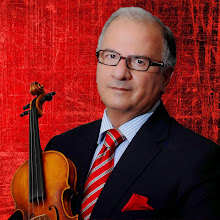
Itzhak Perlman

Born in Israel in 1945, Perlman completed his initial training at the Academy of Music in Tel Aviv. He came to New York and soon was propelled into the international arena with an appearance on The Ed Sullivan Show in 1958. Following his studies at the Juilliard School with Ivan Galamian and Dorothy DeLay, Perlman won the prestigious Leventritt Competition in 1964, which led to a burgeoning worldwide career.

Since then, Itzhak Perlman has appeared with every major orchestra and in recitals and festivals throughout the world. In November of 1987 he joined the Israel Philharmonic Orchestra for history-making concerts in Warsaw and Budapest, representing the first performances by this orchestra and soloist in Eastern bloc countries. He again made history as he joined the Israel Philharmonic for its first visit to the Soviet Union in April/May of 1990 and was cheered by audiences in Moscow and Leningrad who thronged to hear his recital and orchestral performances. In December of 1994 he joined the Israel Philharmonic for their first visits to China and India.

Itzhak Perlman has been honoured with four Emmy Awards, most recently for the PBS documentary Fiddling for the Future, a film about the Perlman Summer Music Program and his work as a teacher and conductor in that program. His previous Emmy Award recognized his dedication to Klezmer music, as featured in the PBS television special In the Fiddler's House.
During the past two years Perlman has also appeared on the conductor’s podium and through this medium he is further delighting his audiences. He has appeared as conductor / soloist with the Chicago Symphony, the Philadelphia Orchestra, the Dallas, Detroit, Houston, Pittsburgh, Seattle and Toronto symphonies.

One of Perlman's proudest achievements was his collaboration with film score composer John Williams in Steven Spielberg's Academy Award winning film Schindler's List in which he performed the violin solos.

His presence on stage, on camera and in personal appearances of all kinds speaks eloquently on behalf of the disabled and his devotion to their cause is an integral part of his life.

Itzhak Perlman will play Beethoven’s violin concerto with the Vancouver Symphony Orchetra next January.

Thursday, October 27, 2005

Finite Element in Music

A finite-element reconstruction showing one of the acoustically important structural modes of the body of a violin is shown in the picture. The snapshot view shows, on a much exaggerated scale, the highly asymmetric vertical displacements and flexural vibrations of the instrument. The results were obtained when the displacement was at its maximum. Note that vibrations of all parts of the instrument are involved in the resonant mode. In particular, the resonances of the front and back plates cannot be considered in isolation from the rest of the instrument, as has often been assumed in the past.

Source: Physics Web

Cremonese Violins

Is there really a lost secret that sets Stradivarius violins apart from the best instruments made today? After more than a hundred years, this question remains highly contentious, provoking strongly held but divergent views among players, violin makers and scientists alike. All of the greatest violinists of our time, certainly believe it to be true, and invariably perform on violins by Stradivari or Guarneri in preference to modern instruments.

Violins by the great Italian makers are, of course, beautiful works of art in their own right, and are coveted by collectors as well as players. Particularly outstanding violins have reputedly changed hands for over a million dollars. In contrast, fine modern instruments typically cost about $10000, while factory-made violins for beginners can be bought for under $100. Do such prices really reflect such large differences in quality? Is it not a fact that one of the reasons that the great Cremonese violins sound so wonderful is because we have always heard them played by the world greatest players?!

The violin is the most highly developed and most sophisticated of all stringed instruments. It emerged in Northern Italy in about 1550, in a form that has remained essentially unchanged ever since. The famous Cremonese violin-making families of Amati, Stradivari and Guarneri formed a continuous line of succession that flourished from about 1600 to 1750, with skills being handed down from father to son and from master to apprentice. The popular belief is that their unsurpassed skills, together with the magical Stradivarius secret, were lost by the start of the 19th century.

Thursday, October 20, 2005

Taq-i-Kasra

Taq-i-Kasra (translated as "The Arch of Khosrow"), now a ruined ancient city, 32 km SE of Baghdad, Iraq (part of Persian Empire, called Ctesiphon then); was constructed at the Sassanid era, Persian Empire Dynasty (224-651 CE.) Legend has it that locals swore that the magnificent vault was the work of genies. The structure was abandoned after Islamic forces defeated the mighty Persian Empire in the 7th century.

The height of the people watching the Taq in the picture may be a good scale to show the approximate span and height of the arch. The young structural engineers should notice that when this shell was designed and built, there were no computers, finite elements, theory of plates and shells, and nothing but engineering talent, touch and judgement.
Free counter and web stats